Nazia Shehnaz Joynab
🎓 MS in Computer Science @ University of Texas, Dallas (Spring 2026 - Summer 2027 Exp.); B.Sc. in Computer Science and Engineering from MIST
🔬 Graduate Researcher @ Dr. Latifur Khan's Lab, UT Dallas
📜 2 publications: TRIS, accepted at Findings of ACL: EMNLP 2026, and a Q2 journal paper in Informatics in Medicine Unlocked (link).
👩💻 Nearly two years of professional experience as a Software Engineer @SCM_DPI Team, Samsung Electronics (Dec 2023 - Oct 2025).
📭 You can reach me out here.
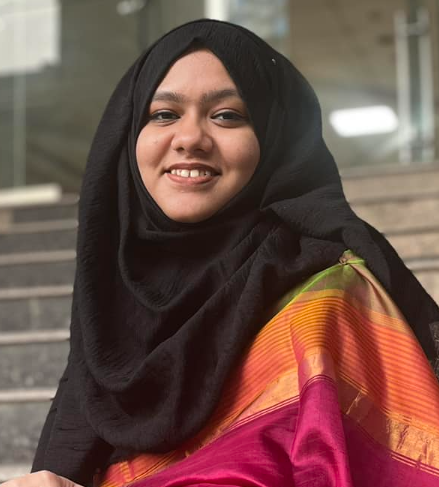
Hey there! I'm Nazia. Pleased to meet you!
I am currently pursuing my Master of
Science in Computer Science at the University of Texas,
Dallas (Spring 2026 - Summer 2027 Exp.), where I work as a Graduate Researcher in
Dr. Latifur Khan's Lab.
Before this, I spent nearly two years as a Software Engineer at Samsung R&D Institute Bangladesh, where I mostly worked on large-scale distributed
systems. I obtained my BSc.(Engg.) degree in May 2023 from the department of Computer Science and Engineering (CSE) at
Military Institute of Science and Technology (MIST).
My research interests lie at the intersection of AI/ML, NLP, and security, with a particular emphasis on
information retrieval and reinforcement learning. Most recently, I contributed to TRIS (Tri-Layer Retrieval
Integrity Sieve), a middleware defense against knowledge poisoning attacks in Retrieval-Augmented Generation (RAG)
systems, accepted to the Findings of the Association for Computational Linguistics: EMNLP 2026.
Besides this, I have explored the efficacy of Federated Learning in healthcare sector as well. my undergraduate thesis focuses on highlighting potential challenges of classifying heterogenous cancerous cells using federated learning, by experimenting in both IID and non-IID settings, under the supervision of Dr. Muhammad Nazrul Islam (MIST). The findings of this research were subsequently published in Informatics in Medicine Unlocked (link).
At Samsung, I was involved in the development and maintenance of an internal Content Delivery Network (CDN), named Artifact Deployment System (ADS). It is a distributed caching system designed to facilitate the rapid and efficient transmission of large binary artifacts across different global research centers of Samsung. The
architectural framework of our system integrates proprietary network accelerators, smart caching mechanisms, proxy configurations, and a public cloud infrastructure to optimize artifact delivery for Samsung's employees and strategic partners.
In my free time, I enjoy travelling and listening to music.
If you require any further information, or want to collaborate on a project, send me an email here.
Research Interests
AI/ML, NLP, Security, Reinforcement Learning, Computer Vision, Robotics
Recent News
Research
* indicates equal contribution